


When and How to Knock in Tongits
Knock in Tongits is the decision to stop chasing another card and put your remaining hand to the test. This article explains when a knock or Draw call is available, how deadwood is counted, and how melds, sapaw, table reads, and timing affect the decision.
Knock in Tongits and the Draw Rule
Tongits belongs to the knock-rummy family, but the traditional Filipino game normally uses the word “Draw” for the action many digital games describe as a knock. The idea is the same: You believe your remaining unmatched cards are low enough to end normal play and force a decision.
A Draw call is different from declaring Tongits. Tongits means you have successfully used all your cards in valid combinations or layoffs. A knock or Draw happens while you still have cards left, so the result may depend on their total point value.
Under commonly documented Tongits rules, opponents who are eligible can either fold or challenge the call. If somebody challenges, the remaining deadwood is compared and the lowest total wins.
That distinction matters because knocking is not simply an “end round” button. It is a calculated decision that exposes your current hand to a comparison.
Draw, Fight and Fold
Once a Draw is called, the other players have a choice.
- Fold: Give up the challenge.
- Fight or challenge: Compare deadwood against the caller.
- Caller: Must survive every valid challenge to take the round.
If both opponents fold, the caller wins without needing a deadwood comparison.
When You Can Knock
Timing comes before strategy. A brilliant five-point hand does not help if the call is not currently allowed.
Open at Least One Meld
Standard Tongits rules require the caller to have opened the hand by exposing at least one valid meld. A meld can be a set of equal-ranked cards or a run of consecutive cards in the same suit.
If you have kept every combination hidden, you generally cannot call Draw. An unopened hand can also become sunog, or burned, when certain round-ending conditions occur.
Opening therefore has two effects: It reduces uncertainty around your eligibility while also giving opponents information about your cards.
Call Before Taking Another Card
A standard Draw declaration happens at the start of your turn, before taking a card.
This creates a genuine decision point. Suppose you are holding only 6 deadwood points. Drawing again could improve the hand, but it could also give the next opponent enough time to unload a Queen or complete a useful meld.
Calling now freezes the situation.
Waiting changes it.
Sapaw Can Block the Call
Sapaw is not only a way to reduce cards. It can interfere directly with knock timing.
If an opponent has added a card to one of your exposed melds since your previous turn, standard rules prevent you from immediately calling Draw. Adding onto your own meld can also create a temporary restriction. You generally need to complete another turn before becoming eligible again.
Check Eligibility Before Counting Points
Before thinking about whether your deadwood is “good enough,” check three things:
- Have you opened a valid meld?
- Has recent sapaw blocked your call?
- Are you at the correct point in your turn to declare?
Only then does the hand-strength calculation matter.
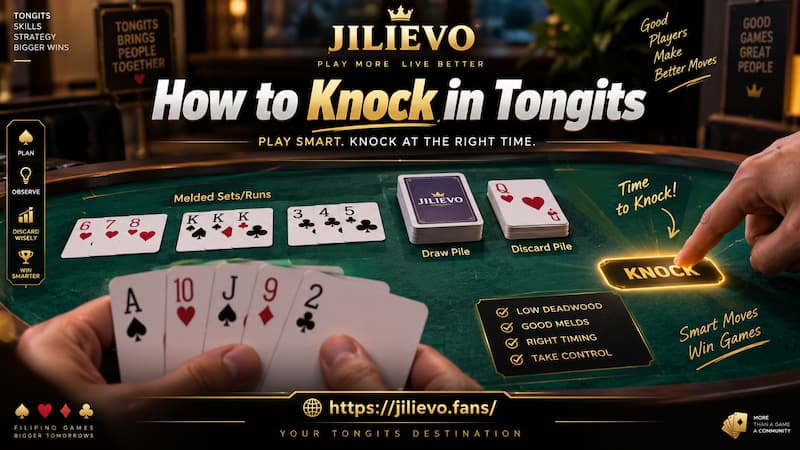
How to Knock in Tongits
A strong knock begins with an accurate count, not a feeling that your hand “looks small.”
How to Knock in Tongits
Count the Deadwood
Only unmatched cards remaining in your hand contribute to deadwood.
Standard card values are:
- Ace: 1 point
- 2 through 9: Face value
- 10, Jack, Queen and King: 10 points each
Consider a hand where all your other cards are already melded and you hold:
- A♠
- 3♦
- 4♣
Your deadwood is 8 points.
Now compare that with holding K♠ and A♦. It is only two cards, yet the total is 11. The number of cards in your hand can be misleading; their point value is what decides a challenged Draw.
Make the Call
Once eligible:
- Count every unmatched card.
- Review exposed melds.
- Recall recent discards and pickups.
- Estimate whether an opponent is likely to challenge.
- Call Draw or Knock before drawing when the applicable rules require it.
A good knock does not require certainty about an opponent’s cards. It requires enough visible information to make stopping stronger than taking another turn.
Prepare for a Fight
If an opponent challenges, deadwood is compared. Under the traditional rules documented by Pagat, the challenger wins a tie against the player who called Draw.
That small rule changes the mathematics of borderline calls.
If you have 7 points and believe an opponent may also have 7, you are not necessarily sitting in a comfortable position. You may need to beat the challenger outright rather than simply match the total.
Strong Timing for a Knock in Tongits
There is no universal “knock at five points” rule. A five-point hand can be excellent at one table and vulnerable at another.
The better question is: How does your deadwood compare with the range your opponents are likely holding?
Low Deadwood With Weak Opponent Progress
Imagine you are down to 6 points while one opponent still appears to be carrying several unmelded cards. The other has opened only one small set and has not recently used sapaw.
That is much stronger than seeing the same 6 points after both opponents have rapidly emptied their hands.
Visible progress matters because every exposed meld removes cards from deadwood. A player with only a few hidden cards may be holding a very tight count.
High Cards Are Still in Play
Kings, Queens, Jacks and 10s are expensive deadwood. Each is worth 10 points.
If an opponent appears to be holding one or two unresolved high cards, your modest total becomes more attractive. On the other hand, seeing those same ranks discarded earlier may reduce the chance that the opponent is still carrying them.
Do not try to memorize the whole deck at once. Start with high-value cards because they can swing the result fastest.
The Stock Is Running Short
A thin stock creates pressure.
Waiting may give you one more chance to cut deadwood. It also gives everyone else another chance.
An opponent could complete a meld, use sapaw, improve to a lower total or even finish the hand with Tongits. As fewer cards remain, the value of “just one more turn” becomes harder to justify when you already have a competitive count.
Situations Where Waiting Is Better
Aggressive knocking feels satisfying when it works, but weak calls often come from confusing a neat-looking hand with a winning hand.
Your Count Is Low but the Table Looks Lower
Suppose you have 9 deadwood points. That sounds reasonable.
Now look across the table. One opponent has opened two melds, recently picked up a discard to complete another combination and has repeatedly removed cards through sapaw.
Nine suddenly feels much less secure.
The exact cards are hidden, but the table has already told you something: That opponent has been reducing deadwood efficiently.
One Expensive Card Dominates Your Hand
A hand containing Q♣ and 2♥ has 12 deadwood points.
Getting rid of the Queen drops the total to 2 immediately. If there are enough useful draws left and the table is not threatening an imminent finish, another turn may carry far more upside than knocking now.
The same thinking applies to any isolated 10-point card.
Waiting Has a Price
Do not turn patience into automatic passivity. One extra turn can improve your hand, but it can also improve two opposing hands.
Before waiting, compare the possible gain against what your opponents can accomplish before the action returns to you.
Reading the Table Before Knocking
Tongits gives away more information than many players use.

Reading the Table Before Knocking
Watch Discard Pickups
Under traditional rules, a player who takes the top discard must use it to create a valid meld rather than simply hiding it in the hand.
That reveals useful structure.
If someone picks up 8♥ and exposes 6♥-7♥-8♥, you now know three cards that no longer contribute to that player’s deadwood. You also know nearby hearts could become useful sapaw cards later.
Track Melds and Sapaw
Visible melds are not decoration. They are part of your estimate.
Watch:
- How many cards each opponent has successfully removed from deadwood.
- Which ranks have already appeared in sets.
- Which suits are developing into long runs.
- Who has recently used sapaw.
- Which high cards have already been discarded.
A player holding four cards is not automatically weaker than someone holding six. Four high-value cards could be disastrous; six small cards could total surprisingly little.
The count behind those cards is the real contest.
Knock Rules When Playing on JILIEVO
When playing Tongits through JILIEVO on the app, use the same decision logic but check the rules displayed inside the specific game before treating any house convention as universal.
Digital versions may use labels such as Knock, Draw, Fight or Fold differently. Tie handling, automatic comparisons, sapaw restrictions and table controls can also be implemented by the game software rather than managed manually.
With real PHP stakes involved, responsible gaming limits can also keep a borderline knock decision separate from pressure to recover money lost in earlier hands.
Knock, Finish With Tongits or Keep Playing
A round can reach a point where all three choices look reasonable. Reduce the decision to the information already on the table.
Knock
A knock becomes attractive when your call is legal, deadwood is already competitive and opponents have shown enough weakness to make a challenge uncomfortable.
Push for Tongits
Continue toward Tongits when the hand has strong completion potential and one more turn could realistically remove the remaining cards. The upside is larger, but so is the risk of giving opponents additional action.
Keep Playing
Stay in the hand when your deadwood still contains an obvious weakness, an opponent appears compressed or another draw has meaningful improvement potential.
Final Decision Check
Before calling Knock in Tongits, run four checks in order:
Eligibility → Deadwood → Challenger range → Cost of waiting.
That takes only a few seconds. More importantly, it turns the knock from a hopeful button press into a decision supported by the cards already played.
- Learn more: How Filipino Color Games Work on Mobile Apps