


How Filipino Color Games Work on Mobile Apps
Color Game Apps bring the familiar color-dice format onto a phone, with the betting board, countdown, results and wallet handled on one screen. The aim here is simple: Explain how a mobile Color Game round works, how PHP bets are settled and which details deserve attention before joining a game.
Color Game Apps and the Mobile Color-Dice Format
Anyone who has seen a Color Game at a Filipino perya will recognize the basic idea almost immediately. Instead of betting around a physical board while three colored dice are shaken, the entire round is moved onto a mobile screen.
A common version uses three dice, with each die carrying six colored faces. Before the timer expires, you select one or more colors and attach a wager to each selection. Once betting closes, the dice determine the result.
The digital format adds a few practical elements:
- A countdown shows exactly when betting closes.
- PHP chip values replace physical cash on the table.
- Selected colors and total stakes remain visible before the roll.
- Results appear automatically.
- Winning and losing bets are settled by the game without manual calculation.
- Previous rounds may be stored in a history or roadmap panel.
The basic idea is simple enough to learn in one round, but individual games are not necessarily identical. Providers can use different multipliers, side bets, jackpots and special dice features.
That distinction is particularly relevant with JILI. PAGCOR’s list of approved electronic games dated March 19, 2026 includes both JILI Color Game and Color Game Extreme as table games.
How a Mobile Color Game Round Works
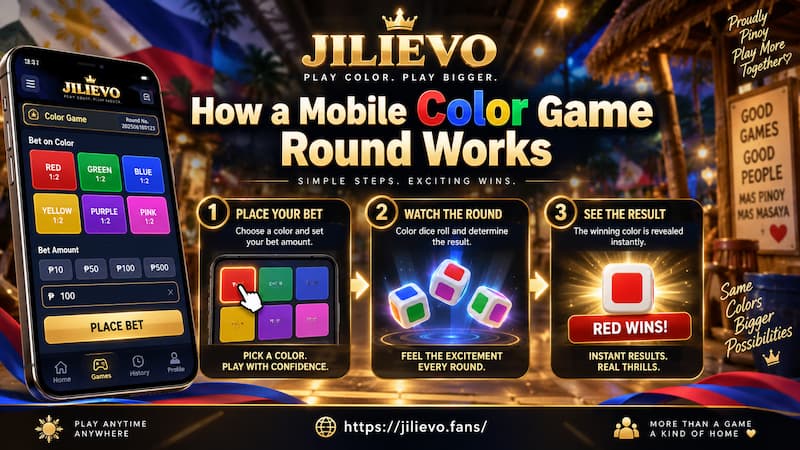
The best way to understand Color Game Apps is to follow one round from the moment the betting board opens until the balance is updated.
How a Mobile Color Game Round Works
Betting Opens
A fresh round normally begins with a countdown. Six colored areas sit prominently on the screen, with selectable chip values nearby.
Suppose your balance is PHP 1,000 and you want to place PHP 100 on Red. You choose the PHP 100 chip and tap Red. If the game accepts multiple selections, you could also put PHP 50 on Blue.
The important number at this stage is not the possible prize. It is the amount currently committed to each betting position.
Betting Closes
When the countdown reaches zero, new wagers stop being accepted. A tap made too late may simply carry no bet into the round.
This short cutoff matters on mobile. A weak connection or delayed screen response can make the last second less reliable than it looks, so the confirmed-bet display is more useful than assuming every tap registered.
The Dice Determine the Result
Once betting closes, the three-dice result appears.
JILI’s own Color Game description confirms the core mechanic: Players select colors, three dice are involved and additional rewards can apply when two or three dice land on the same color.
Depending on the game, the dice may be electronically generated and animated on screen or presented through a live casino setup with a dealer on video.
Electronic Color Game
The full sequence runs digitally. The round closes, the game determines the result and the dice animation reveals the outcome.
Live Color Game
The betting controls remain digital, but a dealer conducts the round on video. The mobile interface still manages the timer, wager confirmation and settlement.
In either case, the result—not the animation speed or previous sequence—is what determines settlement.
Settlement Updates the Balance
Imagine the result is:
Red – Blue – Yellow
If PHP 100 was placed on Red, Red has appeared once. The game checks that outcome against its paytable and settles the wager accordingly.
There is no need to claim winnings manually. The account balance normally updates as the round finishes or before the next betting window begins.
Colors, Multiple Matches and Payouts
The biggest mistake with Color Game is assuming every winning color is treated exactly the same regardless of how many matching dice appear.

Colors, Multiple Matches and Payouts
One Matching Die
Bet: PHP 100 on Red
Result: Red – Blue – Yellow
Red appears once.
Two Matching Dice
Bet: PHP 100 on Red
Result: Red – Red – Green
Red appears twice.
Three Matching Dice
Bet: PHP 100 on Red
Result: Red – Red – Red
All three dice match the selected color.
In many traditional-style implementations, additional matching dice increase the return. JILI also specifically uses double and triple matches as part of its Color Game mechanics, while Color Game Extreme adds features such as Super Dice multipliers.
The paytable shown inside the exact game matters more than a payout figure copied from another Color Game.
That is especially important with Color Game Apps because two games can share the same three-dice idea while calculating rewards differently.
Multiple Colors Can Win Together
Three dice also mean a round does not always have one single winning color.
Suppose you placed:
- PHP 100 on Red
- PHP 100 on Blue
The result is:
Red – Blue – Blue
Both selected colors appear. Red has one match while Blue has two. Each wager is then evaluated under that game’s rules.
This is one reason reading the settlement screen is more useful than simply checking whether “your color won.”
Using Color Game Apps on a Phone
The mobile experience is built around speed, so knowing the controls before placing a wager makes a noticeable difference.
On JILIEVO, Color Game can sit within a broader casino selection, but the controls inside the game itself remain the important part once a round begins.
Entering a Game
A typical mobile flow is:
- Sign in to the casino account.
- Open the relevant game category.
- Select the Color Game title and version.
- Wait for the betting interface to finish loading.
- Check the minimum bet, maximum bet and paytable.
- Confirm the PHP balance before joining a round.
Some Color Game Apps run through an installed application, while others can work through a mobile browser. That delivery method does not automatically change the game rules; the exact provider and version do.
Controls Worth Recognizing
Before the first wager, identify the functions around the board:
- Chip selector
- Betting areas
- Countdown timer
- Confirmed wager amount
- Clear or cancel button
- Repeat bet
- Double bet, where supported
- Previous-round history
- Current balance
The history panel can be interesting to watch, but it needs to be interpreted correctly.
Previous Results Do Not Predict the Next Color
A sequence such as Red, Red, Red across several rounds can easily create the feeling that another color must appear next.
That is not a useful conclusion.
Historical results tell you what already happened. They do not, by themselves, change what the next dice roll must produce. A run of Red does not create a debt that the game has to repay with Blue, Yellow or Green.
This becomes especially important when a mobile interface presents previous results in neat columns or roadmaps. Those visual records are excellent for checking past rounds; they are not evidence that a future color is “due.”
For a chance-based Color Game, the smarter use of history is verification rather than prediction.
PHP Wallets and Game Balances
A mobile Color Game wager usually follows a straightforward balance flow:
Deposit → Account balance → Color Game wager → Round settlement → Updated balance
If you select a PHP 100 chip, PHP 100 is the stake being placed on that position. It should not be confused with the possible amount returned after a win.
Check Payment Options at Account Level
Payment access in the Philippines has changed significantly. PAGCOR stated in November 2025 that e-wallets were mandatorily delinked from online gaming platforms as part of tighter safeguards, with additional payment controls intended to improve traceability and player protection.
For that reason, it is inaccurate to assume every casino automatically supports a direct GCash-to-game flow.
Before making a deposit, check the payment options currently provided and confirm:
- Minimum deposit
- Minimum withdrawal
- Verification requirements
- Processing method
- Transaction history
- Available PHP balance after processing
These account-level details are separate from the Color Game itself.
Checking the Game and Operator
Seeing a familiar provider logo is useful, but it answers only part of the legitimacy question.
PAGCOR maintains approved electronic-game records by provider and game version. Its March 2026 list, for example, confirms approved JILI titles including Color Game.
The operator or domain should still be checked separately.
PAGCOR launched its Guarantee service specifically so the public can verify legitimate online gaming providers rather than relying on logos, screenshots or licensing claims printed on a gaming page.
Account Verification
Regulated online gaming also involves player verification. Current PAGCOR rules state that registration is restricted to people aged 21 and above and require KYC procedures using identification details, government-issued ID and identity verification.
That makes three checks worth separating:
The Game
Confirm the exact Color Game title, provider, rules and paytable.
The Account
Understand KYC, PHP funding, withdrawals and transaction records.
The Operator
Verify the actual gaming domain rather than assuming an approved game automatically makes every casino offering it authorized.
Color Game Apps in Practice
Color Game Apps turn a familiar three-dice game into a compact mobile sequence: Choose a color, set the PHP wager, place it before the countdown ends, wait for the dice and let the game settle the result.
The mechanic is easy. The details deserve more attention.
A different game version can mean different payouts, multipliers, betting limits or bonus features. Previous colors do not predict the next roll, and game approval should not be confused with operator authorization.
Once those distinctions are clear, the mobile Color Game becomes much easier to read. You know exactly what was wagered, why a result won or lost, how the balance changed and which information deserves checking before the next round.