



Why USDT Is Growing in Popularity for Online Betting in the Philippines
USDT is becoming a more visible payment option in online betting because it combines a relatively stable unit of value with wallet-based transfers that can run around the clock. In the Philippines, its role is especially interesting: PHP still anchors everyday spending, while growing crypto familiarity gives bettors another way to move funds where USDT is supported.
USDT as an Online Betting Payment Method
USDT is a stablecoin issued by Tether and designed to track the value of the US dollar. Unlike Bitcoin or Ethereum, where a betting balance can change noticeably simply because the market moves, one USDT is intended to remain close to one USD. Tether states that USD₮ is pegged 1:1 to the dollar and backed by its reserves.
That difference sounds small until money is waiting in a wallet. Someone holding the equivalent of ₱10,000 in a volatile cryptocurrency may see the value move before making a deposit. With USDT, the main purpose is different: Preserve purchasing value while moving digital funds rather than speculate on the token itself.
For betting payments, stability is often more useful than excitement. The payment asset does not need to become the bet.
Wallet-Based Transfers
USDT also changes the transaction path. Instead of relying entirely on a bank account or e-wallet connection, funds can move from a crypto exchange or personal wallet to a supported deposit address.
The transfer can be initiated at night, on weekends, or during holidays because blockchain networks do not follow traditional banking hours. That does not mean every betting deposit is instant. The receiving operator may still require blockchain confirmations, internal processing or account checks before updating the balance.
One Token Across Different Networks
USDT exists on multiple blockchains. Tether currently supports networks including Ethereum, Tron and Solana, among others.
That flexibility is useful, but it introduces one of the biggest practical mistakes in crypto payments: Choosing the wrong network.
USDT-TRC20 and USDT-ERC20 may represent the same underlying stablecoin, yet they travel through different blockchains. A cashier requesting TRC20 should not be treated as an Ethereum address simply because both transfers involve USDT.
USDT Adoption in the Philippine Payment Environment
Crypto is hardly unfamiliar in the Philippines. Chainalysis ranked the country ninth overall in its 2025 Global Crypto Adoption Index and sixth for retail centralized-service activity. Those figures do not prove that USDT has captured a specific percentage of online betting deposits, but they do show that exchanges, wallets and digital assets already have a substantial local user base.
That distinction matters. There is no reliable public dataset showing exactly how much Philippine online betting volume is funded through USDT. Its growing presence is better understood through payment behavior: More people already know how to buy crypto, copy wallet addresses and move assets between exchanges and wallets.
A Familiar Workflow for Existing Crypto Users
For someone who already holds USDT, using it for a supported betting account can feel straightforward. There is no need to convert PHP for every individual transaction. The same balance can remain in a wallet until needed.
The picture changes for someone starting entirely in Peso. Buying USDT only to make one small deposit adds extra steps, and those steps can carry costs.
Digital Betting Payments Have Changed
Philippine payment rules also became tighter in 2025. Bangko Sentral ng Pilipinas instructed BSP-supervised institutions to remove links providing in-app gambling access from mobile payment apps and websites. PAGCOR subsequently described mandatory e-wallet delinking as part of broader safeguards for regulated online gaming.
USDT should not be treated as a way around those controls. It is simply a different payment rail, and crypto transactions can still involve identity verification, monitoring and compliance requirements.
USDT and PHP Follow Different Money Paths
PHP remains the clearest reference point for everyday budgeting in the Philippines. If you earn, save and spend in Peso, a direct PHP payment avoids an additional currency conversion.
USDT becomes more attractive when the funds are already held in crypto.
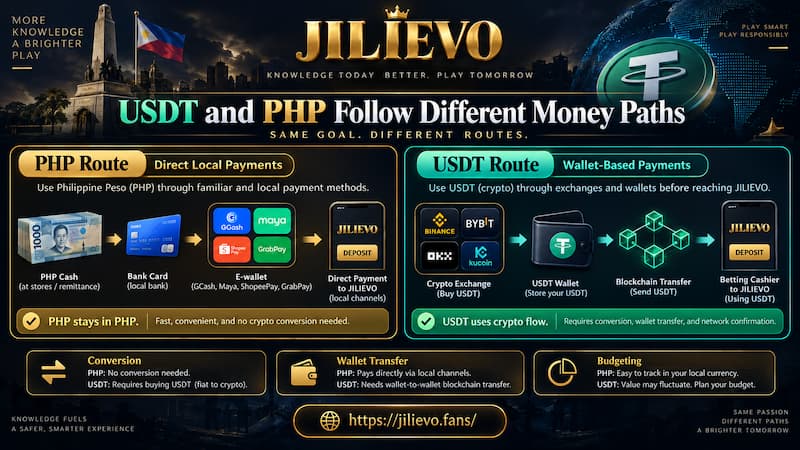
USDT and PHP Follow Different Money Paths
Consider a simple ₱5,000 example. Starting with PHP could involve:
- Funding a regulated crypto exchange or virtual asset service provider.
- Converting PHP into USDT.
- Withdrawing USDT to a personal wallet, if required.
- Sending it through the exact network accepted by the betting account.
- Converting funds back again when eventually returning to PHP.
Each stage can affect the final amount.
The Real Cost Is More Than Gas Fees
A common mistake is comparing only the blockchain fee with an e-wallet transfer fee. The total cost can include:
- PHP-to-USDT trading spread or conversion fee
- Exchange trading charges
- Exchange withdrawal fees
- Blockchain network fees
- Operator deposit or withdrawal charges, where applicable
- Another conversion cost when USDT returns to PHP
For a person already holding USDT, several of those costs may disappear. For someone purchasing USDT specifically for a ₱500 or ₱1,000 deposit, the economics can be much less attractive.
Deposit Speed and Withdrawal Speed Are Separate Issues
A blockchain can confirm a transfer quickly while the betting balance remains pending.
There are really two clocks running: The blockchain confirmation time and the operator’s processing time. Withdrawals add another layer because identity verification, account checks or withdrawal review may happen before USDT is sent.
A transaction hash showing “confirmed” therefore does not always mean the cashier must already show the funds.
Depositing and Withdrawing USDT Correctly
The most important part of a USDT payment happens before pressing Send. Crypto transactions are difficult or impossible to reverse once confirmed, so a five-second address check can matter more than saving a few minutes.
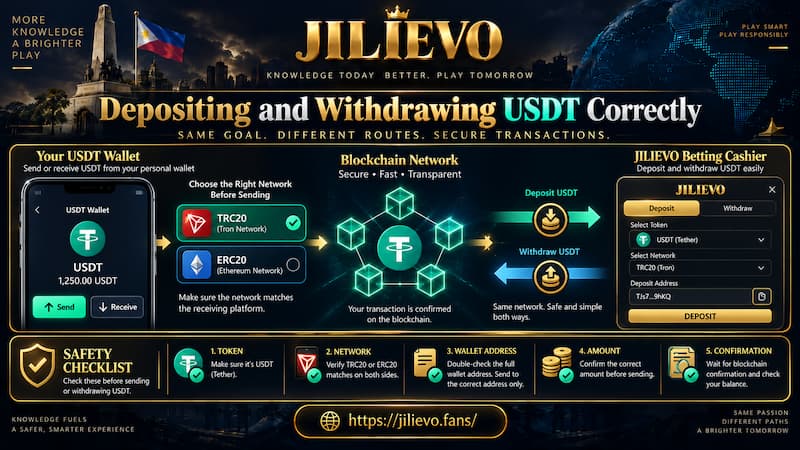
Depositing and Withdrawing USDT Correctly
Before Sending USDT
Check four items first:
- Token: USDT
- Network: Such as TRC20, ERC20 or the specific network displayed
- Wallet address: Compare the beginning and ending characters
- Amount: Confirm minimum and maximum transaction limits
For an unfamiliar address, a small test transfer can be sensible when the fee structure makes that practical.
Match the Network Exactly
Do not choose a network because it happens to be cheaper in your wallet. Use the network specified by the receiving cashier.
Sending through the wrong chain can leave funds unrecoverable or require a complicated recovery process that may not be available at all.
A Typical USDT Deposit
The practical flow usually looks like this:
- Open the deposit area and choose USDT.
- Select the supported blockchain network.
- Copy the displayed wallet address.
- Paste it into your sending wallet and verify it.
- Enter the amount.
- Confirm the transfer.
- Keep the transaction hash until the balance is credited.
USDT withdrawals reverse the direction, but the same network discipline applies. Your destination wallet must support the network being used.
BSP guidance also makes clear that virtual asset service providers can apply enhanced due diligence to transfers involving unhosted wallets. Crypto therefore does not automatically remove KYC or transaction-monitoring requirements.
USDT Payments at JILIEVO
For a Philippine betting brand such as JILIEVO, USDT is most useful when it sits alongside PHP-based payment choices rather than trying to replace them entirely.
Public JILIEVO-related material has listed USDT among available payment channels, but payment details across associated domains are not fully consistent. That makes the live cashier more important than an old article or screenshot when checking current availability.
Check the Cashier Before Moving Funds
Before buying USDT specifically for a JILIEVO deposit, confirm:
- Whether USDT is currently available
- Which blockchain network is accepted
- Minimum deposit and withdrawal amounts
- Whether withdrawals use the same network
- Whether account verification is required beforehand
This simple check prevents a poor situation where PHP has already been converted into crypto but the expected network is unavailable.
Payment Support Does Not Prove Licensing
USDT acceptance also says nothing by itself about regulatory status. PAGCOR introduced its Guarantee service so consumers can verify legitimate online gaming providers, while PAGCOR states that all offshore Internet Gaming Licensees and Authorized Providers were cancelled effective December 15, 2024.
Payment convenience and licensing should always be evaluated separately.
Risks Behind the Convenience
USDT removes some friction, but it creates different responsibilities.
A wrong wallet address can be far more serious than mistyping an e-wallet number that triggers a familiar dispute process. Network selection also matters every time funds move.
Stable value should not be confused with guaranteed value either. USDT is designed to track USD, but stablecoins still carry issuer, custody, exchange and market risks.
There is also the budgeting effect. A wallet balance displayed as “200 USDT” can feel detached from everyday Peso spending. Converting that amount mentally back into PHP before betting helps keep the transaction connected to real money rather than abstract digital units.
USDT’s Place in Online Betting Payments
USDT fits Philippine online betting best when the user already understands crypto and already holds the token. In that situation, stable value, 24/7 blockchain access and wallet portability can make payment handling remarkably convenient.
Starting from PHP changes the calculation. Conversion fees, network selection, withdrawal processing and the eventual move back into Peso all deserve attention.
USDT is therefore not automatically better than local payment methods. Its strongest use case is much narrower and more practical: The right network is supported, the full transaction cost makes sense, and the person sending it understands exactly where the funds are going.